
The Man Who Tried to Outsmart Football
From betting markets to Brentford, Matthew Benham turned probability, data and patience into a new way of thinking about football. A story about finding value where others see risk.

There are people who enter football through money. They buy clubs, they buy players, they buy time. And then there are those who enter football through an entirely different door, only to discover that what they have spent their whole lives learning can also be applied to the game they loved as boys.
Matthew Benham belongs to the second kind.
How Benham Turned Betting Into a Data Business
His story begins far from the pitch, in the world of physics, finance and derivatives, where he learned what would later become his most important lesson in football: that beneath chaos there is often a pattern. That risk is not the same as randomness. And that what appears unpredictable is sometimes simply something that has not been measured well enough.

Benham studied physics at Oxford, then spent years working in the financial world before making a move that would eventually make his biography seem almost improbable. At the beginning of the new millennium, he entered the world of professional sports betting.
But this is precisely where the misunderstanding about him begins. Benham made money from betting, but he was not a gambler in the traditional sense. He was not drawn to the thrill of the wager, he was not interested in luck, and he was not looking for adrenaline. He was interested in mathematics.
For him, betting was a market. And every market, if you watch it long enough, reveals its mistakes.
He worked with Tony Bloom, the future owner of Brighton, developing models for predicting football results. He later founded Smartodds, a company that began providing professional bettors with what Benham understood best: statistical models, data and a way of thinking that turned football into a system of probabilities.
In other words, he was not trying to predict what would happen. He was trying to calculate how likely it was that something would happen. The difference may seem small, but it is precisely where his entire story begins. Because a man who had spent years studying how markets make mistakes eventually decided to buy the market he had loved most of all — a football club called Brentford.
Why Matthew Benham Bought Brentford
Benham had supported Brentford since he was a boy. He did not discover the club after becoming wealthy; he did not buy it because he was looking for another business project. The connection existed long before the money. When Brentford ran into financial difficulties, Benham initially helped from the background before gradually taking control. In 2012, he became the club's majority owner.

And that was when the story took its most interesting turn. The new owner did not start buying big-name players. He did not try to copy the wealthy clubs. He did not even try to beat them at their own game. He decided to change the game.
If the big clubs had more money, Brentford would try to have more information. If others paid for reputation, Brentford would look for what reputation concealed. If others watched the player, Brentford would look at the data behind the player.
Football became a laboratory. Every transfer was a hypothesis. Every player was an investment with a certain level of risk. Every detail of a match was a potential inefficiency to be identified before someone else found it.
How Brentford Built a Data-Driven Football Model
In that sense, Benham's philosophy was close to Moneyball, but also something more than that. He was not simply looking for undervalued players. He was trying to build a club that made decisions differently from the majority. Brentford became a kind of football hedge fund.
Not because it had lost its soul, but because it was trying to survive in a world where money had become an almost insurmountable advantage. And it worked. A club that had spent years drifting through the lower divisions of English football reached the Premier League in 2021. There, it did not collapse under the weight of the bigger clubs. Instead, it continued to operate according to the same logic: find value before the market recognizes it.
Then Benham did something that turned his idea into an experiment. In 2014, he acquired a majority stake in Danish club FC Midtjylland. If Brentford was his main project, Midtjylland became a second laboratory. The same ideas were applied in a different market, within a different football environment.
The results were not limited to tables and graphs. Midtjylland won the Danish championship and reached the Champions League. Benham sold his majority stake in 2023, but his story did not end there. Quite the opposite. After Midtjylland, he began building something broader than a single club. Brentford remained at the center, while through Best Intentions Analytics, his football story expanded into Spain with AD Mérida.
And that is precisely why Matthew Benham is more interesting than most football billionaires.
His biography has an almost perfect narrative arc. A boy who falls in love with a small London club. A physicist who moves into finance. A financier who enters the betting business. A man who makes money precisely because he understands where markets are wrong. And then, instead of spending that money on one of the world's biggest clubs, or simply on his own pleasures, he returns to the club he supported as a child and tries to make it better by applying the same principles to football.
First, he tried to beat the bookmakers. Then he tried to improve football.
In a sport that had spent centuries feeding on intuition, character, reputation and myth, he put forward an uncomfortable proposition: perhaps most clubs simply do not see what is right in front of them.
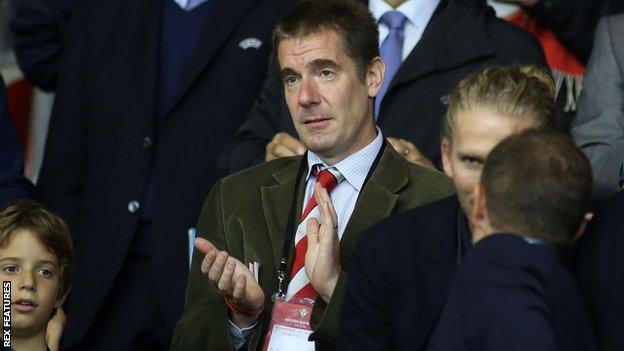
Perhaps a player is worth more than the market believes. Perhaps a certain situation creates a greater probability of scoring than a coach assumes. Perhaps millions can be saved if a decision is made an hour before everyone else. That is Benham's real paradox.
The man who made his fortune from betting did not become a football owner because he loved gambling. He became an owner because he believed risk could be understood. And that is where his story stops being the story of one English football club. It becomes the story of an idea:
A small club does not have to become big to beat the big one. It only has to see it a little more clearly.

