
The Algorithm of Fate
Inside the people, technology and rules behind UEFA’s biggest draw and perfectly orchestrated television event

There are moments in football that last less than a second, yet have months of work behind them. One such moment happens every year at the end of August in Monaco.
On the stage at the Grimaldi Forum stand presenters, former footballers and UEFA officials. Behind them, a giant screen. In front of them, the balls. The cameras are ready. Millions of viewers are waiting for the same thing.
Someone draws a club. Someone else presses a button. And then eight opponents appear on the screen. It looks like chance. In reality, almost nothing surrounding that moment has been left to chance.
Because the modern UEFA draw is no longer simply a matter of taking balls out of a bowl. It is, at the same time, a sporting procedure, a mathematical problem, a computer system, a television production, a logistical operation, a security protocol and, perhaps most importantly, a performance of chance.
And all of it takes place in a Monegasque space somewhere between the sea, hotels, casinos and Formula 1. At the Grimaldi Forum.
O4 BRIEF
WHAT HAPPENED?
UEFA has transformed the traditional club draw into a hybrid digital system: a person draws the club, while software determines its eight opponents and the home-and-away allocation within UEFA’s rules.
WHY DOES IT MATTER?
With 36 clubs and eight opponents per club, the old manual system became impractical. UEFA says a traditional draw would require almost 1,000 balls and at least 36 bowls. The new system has to preserve randomness while respecting complex constraints and avoiding mathematical deadlocks.
THE BIGGER QUESTION
If a computer now determines most of the outcome, what exactly makes a draw a draw, randomness, or the performance of randomness? UEFA has therefore subjected the system to independent review, while AE Live tested it through more than one million simulations.
SOURCES
MONACO
The Grimaldi Forum is not a football stadium. There is no pitch. No terraces packed with supporters. No goals. Yet for years, it has been one of the places where European football determines its future.
For the 2026/27 season, UEFA once again chose the venue for its major club competition draws. The Champions League draw took place on 27 August, with the Europa League and Conference League draws following the next day.
At first glance, the building feels like a perfect metaphor for what happens inside.
The Grimaldi Forum covers around 85,000 square metres in total, with more than 41,000 square metres of flexible indoor space. Its largest hall, the Salle des Princes, can accommodate 1,864 people and features a stage of roughly 1,000 square metres.
This is not a small room in which a television programme happens to take place. It is event infrastructure. And that distinction matters.
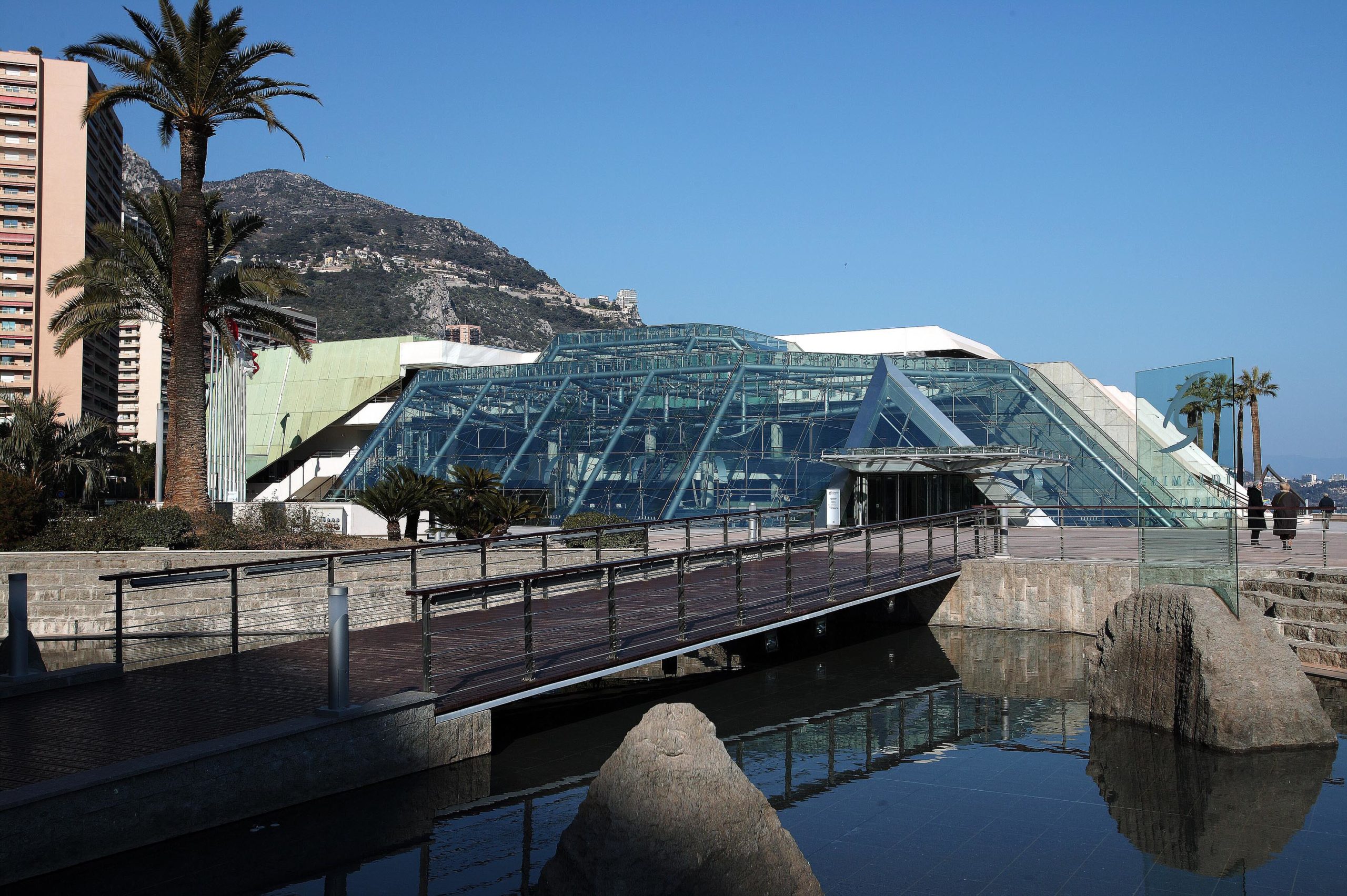
Because what the television viewer sees as a single stage is actually only the front of a vast system stretching behind it. The Grimaldi Forum itself has a team of 144 specialists covering project management, logistics, audiovisual production, catering, hospitality, security and communications.
How many of them work on a UEFA draw? UEFA does not publish that number today. But history gives us a sense of scale.
Back in 2002, when UEFA described the preparations for its Monaco draws, Stéphanie Theintz, then UEFA's draw coordinator, spoke of around 40 people working full-time for two to three days simply to prepare the event. UEFA, television and production companies, as well as graphic-design teams, were all involved. And before those two or three days? Two to three months of planning.
Twenty-four years later, the balls have become more digital. The operation has not become simpler. It has simply become less visible.
WHAT THE CAMERA DOESN'T SEE
On television, everything looks almost offensively simple. A person takes a ball. Opens it. Reads the name. The audience applauds. The graphic appears. Next ball.
But UEFA's new generation of draws operates according to an entirely different logic.
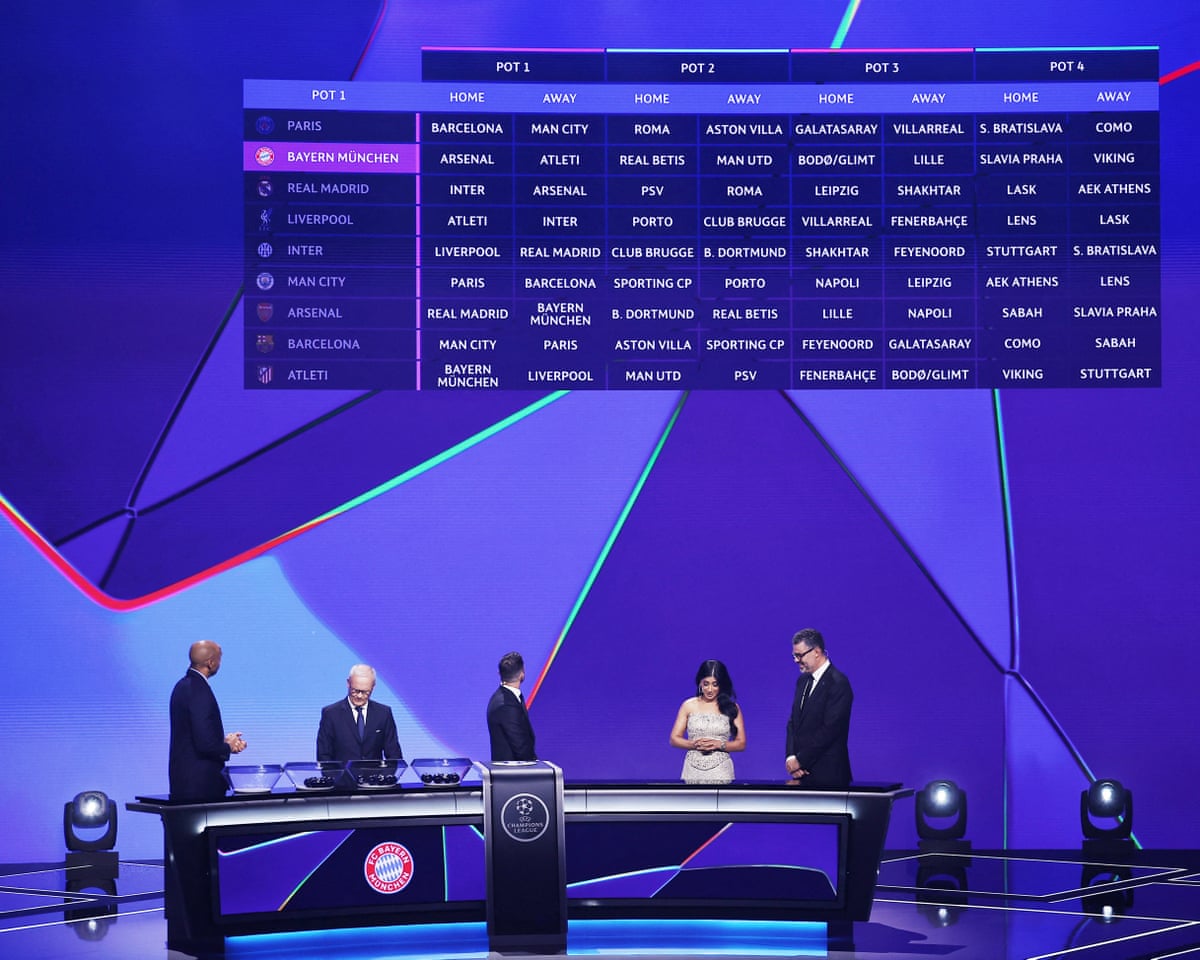
The Champions League now features 36 clubs divided into four pots of nine. Each club receives eight opponents, two from each pot, with one home and one away fixture against each pot. In principle, clubs cannot face another club from the same national association, while there is also a limit of two opponents from any other individual association. UEFA can also adjust the draw conditions to prevent the entire system from reaching a mathematical deadlock.
And that is where the problem begins. A human being can draw a ball. But a human being cannot, within a few seconds, calculate all the consequences that ball might have for the remaining 35 clubs.
A computer can. And that is why UEFA had to change something that, for more than half a century, had been understood as a football draw.
AE LIVE
There is a company at the centre of this story that probably means very little to the average football fan. It is called AE Live. But without it, today's draw would look very different.
AE Live is not a conventional software company. It works across sports broadcast technology, graphics, data, automation and production. Its portfolio includes major sporting organisations and broadcasters such as FIFA, the BBC, Sky and the Premier League.
For UEFA, the relationship became official in September 2023, when AE Live was appointed its draw technology partner across UEFA competitions. But the idea did not appear overnight. According to Dave Gill, AE Live's Chief Technology Officer, UEFA had been discussing the possibility of a digital draw for almost six years before deciding to introduce it for the new competition cycle.
AE Live first had to prove its concept through a tender process. Work on the project began in August 2023. The first major UEFA draw using the new system took place a year later. So when someone in Monaco pressed a button for the first time in 2024 and allowed a computer to determine the opponents, that button was not the beginning of the project. It was the end of it.
THE PROBLEM THAT BECAME TOO BIG FOR A BALL
There is something almost romantic about the old football draw.
A bowl. Balls. A hand. A name. Fate. But romance has its limits. When UEFA expanded the competition to 36 clubs and had to assign eight opponents to each of them, the traditional model began turning into a mathematical nightmare.
UEFA itself calculated that a manual draw under the new format would require almost 1,000 balls and at least 36 bowls. And it would take an impractical amount of time. That was when one of the more interesting transformations in modern sport took place.
The ball did not disappear. It simply stopped being enough. Today, in the Champions League, a human being draws the club, and then the computer takes over.
This is the moment when the traditional idea of the draw begins to crack. Because we are no longer watching a single type of randomness. We are watching randomness constrained by rules.
RANDOMNESS THAT HAS TO KNOW THE RULES
This is perhaps the central paradox of the entire story.
The draw has to be random. But it cannot be arbitrary. Barcelona cannot play just anyone. Arsenal cannot play just anyone. No club can simply receive eight random opponents.
The software has to search for randomness within a space that UEFA has already defined. And then comes the harder question. It is not enough to ask: Can this match be played? You have to ask: If we choose this match now, can the entire draw still be completed afterwards?
In other words, the computer is not looking only at the present. It is looking at the consequences. If a particular combination closes too many possibilities for the remaining clubs, the system has to find another path.
That is why UEFA's regulations explicitly allow the draw conditions to be adjusted in order to avoid so-called deadlock situations. This is no longer a child's game of pulling pieces of paper from a hat. It is an optimisation problem taking place in front of television cameras.
ONE MILLION ATTEMPTS
And now we arrive at the number that perhaps best explains how serious the system behind a single television second really is. AE Live and UEFA tested the software with more than one million simulations. Let's write that as a number:
1,000,000 simulations
For different configurations of each competition. Not once. Not as a demonstration. More than one million simulations per competition to test whether the system could operate under different circumstances.
And then, after all of that, a person on stage presses a button. Once. It may be the strangest image of the modern draw. One million simulations behind a single press.
BUT WHO TRUSTS THE COMPUTER?
This is where Ernst & Young enters the story. Because there is a problem that is not mathematical. It is a problem of trust.
If software determines the opponents, who guarantees that the process is random? Who guarantees that the algorithm is correct? Who guarantees that the rules have not been quietly adjusted? UEFA therefore did not leave the matter to AE Live's word.
The development of the system was independently reviewed by Ernst & Young, particularly with regard to randomness and compliance with the rules. EY also participates in the supervision and control of the manual and digital draw process at the venue itself.
It creates an unusual chain of trust. UEFA sets the rules. AE Live builds the system. Ernst & Young checks the system. And the audience watches the ball.
That final fact contains the entire irony. The audience still needs the ball. Even though the ball is no longer what determines most of what we are watching.
THE MAN WHO DOESN'T SEE THE CODE
In an interview with SVG Europe following the first new-format draws, AE Live CTO Dave Gill described the project from the perspective of the people who built it. Their job was not simply to write a “draw algorithm”.
AE Live worked on the entire system: the underlying draw logic, result generation, printouts for clubs and media, feeds for the people running the draw, in-venue graphics, and television graphics. In other words, the computer choosing the opponents is not isolated. It is part of a production organism. The result generated by the software has to become information on a screen almost instantly.
The presenter has to see it. The viewer has to see it. The club has to receive it. The media has to receive it. It has to become part of the official documentation.
All within seconds.
BEHIND THE SCREEN
For the graphics, AE Live used Vizrt, a long-standing technology partner, for the giant screen inside the auditorium as well as broadcast graphics.
Which means that behind the stage, there is another draw taking place. Not a draw of clubs. A draw of information.
When the software makes a decision, that decision has to travel through the system to different people and different screens. One piece of information. Multiple destinations. One result. Multiple versions.
And everything has to remain synchronised. Because television does not forgive a three-second delay. And a graphics error during a draw does not look like a technical error. It looks like UEFA made a mistake.

EUROPA LEAGUE: AN EVEN GREATER PARADOX
And then there is the Europa League.
This is where the story becomes almost philosophical. Under the new system, UEFA can conduct the entire draw digitally, with a single press of a button. The software determines all the pairings and all home-and-away assignments.
But the audience does not see everything at once. The results are then revealed gradually, pot by pot. In other words: the draw can be finished before the audience even knows it has finished.
It is a fascinating transformation. Because we now have to distinguish between two things that used to be one: The draw and the show.
Once, the show was a consequence of the draw. Today, the show is part of the design of the draw.
WHEN RANDOMNESS BECAME DRAMATURGY
Perhaps this tells us something broader about modern sport. Football has always sold uncertainty.
Nobody knows whether the ball will go in. Nobody knows who will win. Nobody knows who will draw whom.
But as football became bigger, uncertainty itself had to become more precisely organised.
More clubs. More matches. More television rights. More rules. More logistics. More money. More people. And so what was once a question of the hand became a question of the algorithm.
But UEFA could not allow the viewer to see the algorithm. An algorithm is not romantic. A ball is. So the ball stayed.
THE DRAW ROOM
That is why it would be wrong to say that UEFA's draw is no longer random.
It is random.
But randomness is no longer the whole story. It is only one element of the system. The system has to be random. But also verifiable. It has to be fast. But also understandable. It has to follow the rules. But it must also be capable of responding when those rules create a mathematical dead end. And perhaps most importantly, it has to work. But it also has to look like it works.
Because sport does not produce only results. Sport produces moments.
And the moment when someone in Monaco presses a button is one of the purest examples of modern sport. Behind it is not just an algorithm. Behind it is an entire industry. Inside the Grimaldi Forum, European football once again attempts to convince the world that fate has just happened.
And fate does happen. It simply had an entire industry working behind it first.

