Google signs PSG, Bayern and Barcelona all within an 8-day window
Google’s European football strategy signals a new era of sponsorship, no longer just buying visibility, but becoming part of the fan experience itself

Three clubs. Three countries. Eight days.
Between August 3 and August 11, Google announced new football partnerships with Paris Saint-Germain, FC Bayern München and FC Barcelona. On August 3, it was PSG. On August 10, Bayern. On August 11, Barcelona. The timing is striking. The structure is even more revealing.
Across all three agreements, Google is positioning Gemini as the club's official consumer AI partner and Google Pixel as its official smartphone partner. The details vary from club to club, but the strategic idea remains remarkably consistent: use football as a distribution channel for Google's consumer technology, and use technology to move the fan relationship beyond the 90 minutes on the pitch.
At PSG, the partnership runs through 2029, with Gemini becoming the club's Official AI Assistant and Pixel its Official Smartphone. Gemini will support the creation of fan-facing content, while Pixel will be used to capture and distribute moments from the pitch and behind the scenes. PSG will also introduce a dedicated Google space at Parc des Princes focused on the company's latest innovations, particularly artificial intelligence.
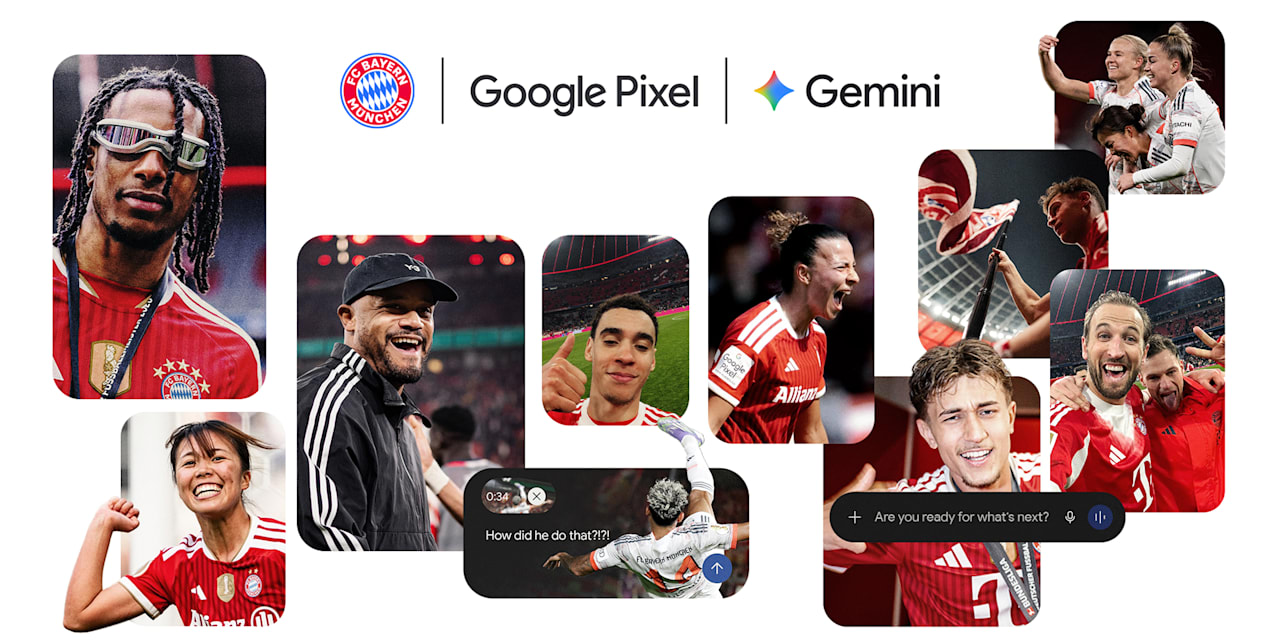
Bayern is following essentially the same playbook. Gemini becomes the club's first Official Consumer AI Partner, while Pixel becomes its Official Smartphone Partner for both the men's and women's teams. Gemini is being positioned as a tool for tactical analysis, statistics and matchday interaction, while Pixel will provide weekly behind-the-scenes content from Säbener Straße and the Allianz Arena.
Then came Barcelona. On August 11, Google Gemini and Google Pixel became new FC Barcelona partners, with Gemini taking the Official Consumer AI Partner role and Pixel becoming the club's Official Mobile Phone Partner. Barcelona says Gemini will give fans AI-powered ways to understand tactics, generate chants and imagine experiences from the pitch, while Pixel will power exclusive digital content around both the men's and women's first teams.
The individual announcements are interesting. Together, they tell a much bigger story.
This is not really about three sponsorships
Google has been building its presence in football for years. Pixel already has partnerships with England's national teams, Arsenal and Liverpool, using the smartphone camera as a way to give fans access to content and perspectives they would not normally see.
In Germany, Google Pixel has gone even further. It has been the naming-rights partner of the women's Bundesliga since 2023, while also partnering with the German women's national team. The DFB extended the national-team partnership through 2029 in 2025.
The three new deals therefore do not represent a sudden move into football. They represent an escalation. Google is moving from individual football partnerships towards something much closer to a global football ecosystem. And the choice of clubs is telling. PSG gives Google Paris, France and one of the fastest-growing global football brands. Bayern gives it Germany's most commercially powerful and historically dominant club. Barcelona gives it one of the world's most recognisable football brands and an enormous international fan base. These are not experimental partnerships. They are distribution platforms.
Gemini changes the equation
For years, sports sponsorships involving technology companies were largely about branding: logos on LED boards, content series, player appearances and product placement. Gemini changes the proposition because the technology can actually become part of the fan experience.
At Bayern, for example, fans can use Gemini to explore tactical analysis and opponent statistics. Barcelona is positioning Gemini as an interactive football analyst capable of helping fans understand the game in new ways. PSG is integrating Gemini into the club's content ecosystem and broader digital experience.
That creates a fundamentally different type of sponsorship. The club is no longer simply advertising Google's product. It is helping make the product useful. It creates a loop in which sponsorship, content, product demonstration and fan engagement become parts of the same system.